Advantages of slot-die coating in advanced materials science
Slot-die coating sets wet thickness from flow, speed, and gap rather than from operator technique, which is what makes a film reproducible between people, substrates, and sites.
From beamline to web
The same recipe logic carries from a single heated substrate to a continuous 15 m web, and onward to pilot-scale roll-to-roll systems. A mechanism understood in the beam can be reproduced at scale.
Milliliter-scale screening
Ink volumes down to a single milliliter make screening viable when the material costs more than the experiment. Formulation work stops being gated by how much precursor can be synthesized.
Protection for sensitive precursors
Fume-hood and glovebox configurations keep air- and moisture-sensitive materials intact between container and substrate. The sample that reaches the measurement is the sample that was made.
Drying as a controlled variable
For oriented materials, the drying profile decides whether the ordering survives. Programmable IR, hot-air, and UV ramps, with substrate heating to 200 °C and head heating to 80 °C, make drying a parameter rather than an uncontrolled step.
Inks that resist being handled
Exfoliated nanosheets, colloids, and metal-organic precursors are low in viscosity and easily damaged by shear. A closed, pre-metered flow path handles fluids up to 20,000 cP and works from a single milliliter.
Films thin enough that coverage is the property
In few-layer 2D materials and nanometer-scale dielectrics, a thickness variation changes carrier transport or dielectric response rather than just missing a tolerance. Pre-metered deposition sets the wet film by flow, speed, and gap, and non-contact coating leaves fragile layers beneath undisturbed.
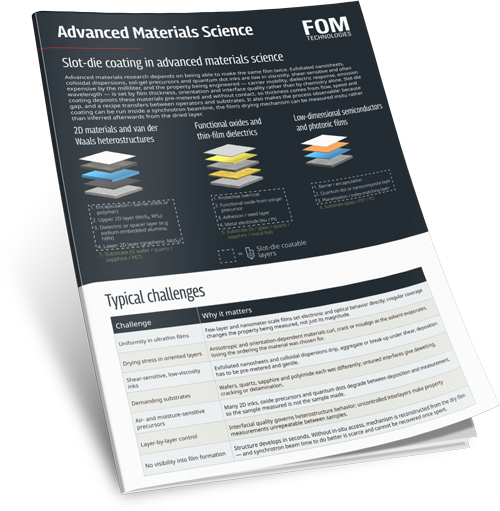
Material systems vary widely, but slot-die coating is a core method for functional films that need pre-metered, non-contact deposition. In the diagrams below, layers shown in gold are slot-die coatable; the others are substrates, or electrodes that are sputtered and lithographically patterned.
2D materials and van der Waals heterostructures
(graphene, MoS₂, WS₂, hBN and other transition metal dichalcogenides)

- Encapsulation / barrier (hBN or polymer)
- Upper 2D layer (MoS₂, WS₂)
- Dielectric or spacer layer (e.g. sodium-embedded alumina, hBN)
- Lower 2D layer (graphene, MoS₂)
- Substrate (Si wafer / quartz / sapphire / PET)
Gold = slot-die coatable layers
Functional oxides and thin-film dielectrics
(high-k dielectrics, ferroelectrics, piezoelectrics)

- Protective overcoat
- Functional oxide from sol-gel precursor
- Adhesion / seed layer
- Metal electrode (Au / Pt) — sputtered and lithographically patterned
- Substrate (Si / glass / quartz / sapphire / metal foil)
Gold = slot-die coatable layers
Low-dimensional semiconductors and photonic films
(quantum dot layers, hybrid nanocomposites, photoresponsive polymers)

(quantum dot layers, hybrid nanocomposites, photoresponsive polymers)
Gold = slot-die coatable layers
Typical coating challenges
Advanced materials research depends on being able to make the same film twice, and the property being engineered — carrier mobility, dielectric response, emission wavelength — is set by thickness, orientation, and interface quality rather than by chemistry alone

Uniformity in ultrathin films
Few-layer and nanometer-scale films set electronic and optical behavior directly, so irregular coverage changes the property being measured, not just its magnitude

Drying stress in oriented layers
Anisotropic and orientation-dependent materials curl, crack, or misalign as solvent leaves, losing the ordering the material was chosen for

Shear-sensitive, low-viscosity inks
Exfoliated nanosheets and colloidal dispersions drip, aggregate, or break up under shear, so deposition has to be pre-metered and gentle

Substrates and interfaces
Wafers, quartz, sapphire, and polyimide each wet differently, and uncontrolled interlayers make property measurements unrepeatable between samples

Air- and moisture-sensitive precursors
Many 2D inks, oxide precursors, and quantum dots degrade between deposition and measurement, so the sample measured is not the sample made

No visibility into film formation
Structure develops in seconds, and without in-situ access the mechanism has to be reconstructed from the dry film — while synchrotron beam time is scarce and cannot be recovered once spent
In-situ characterization with the FOM photonR2R
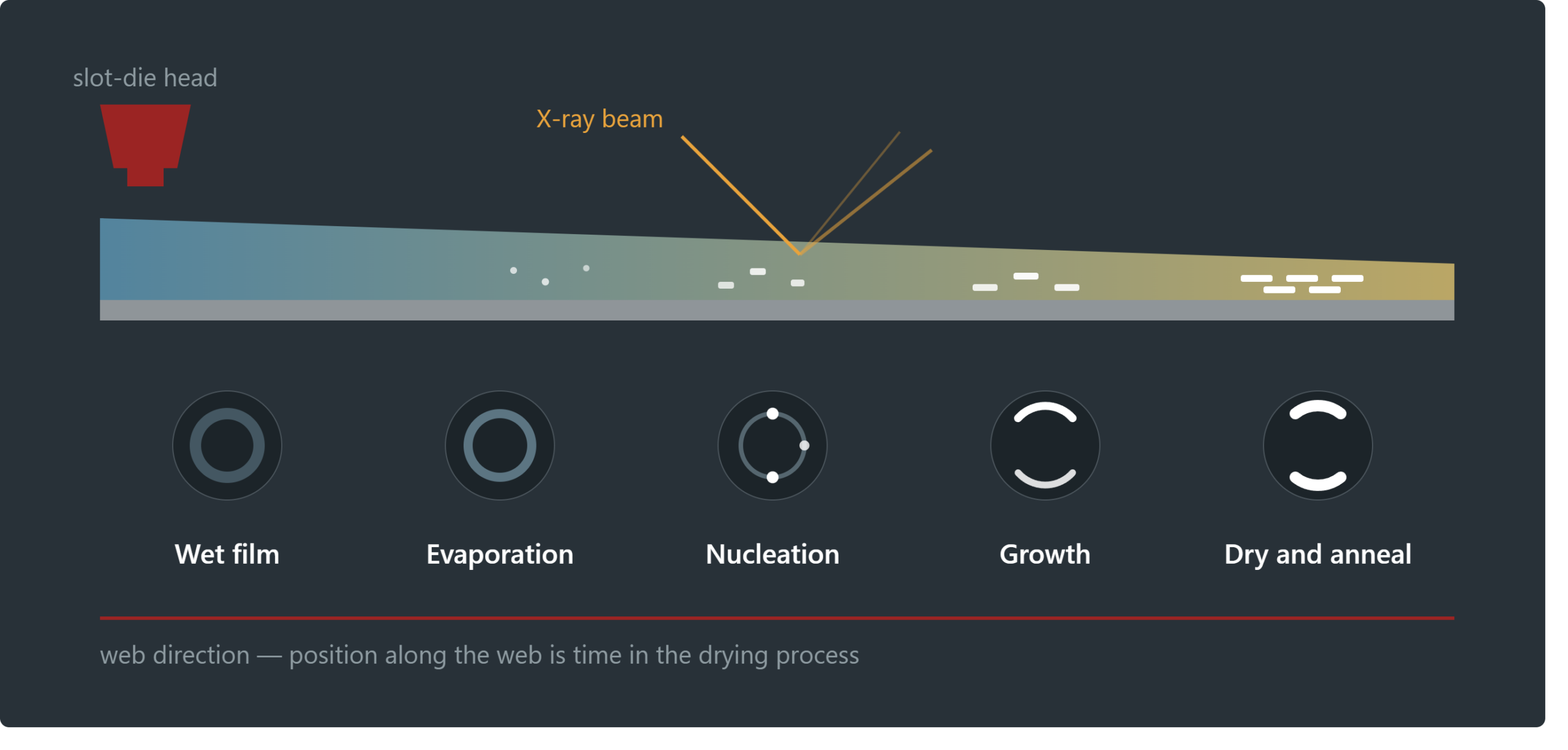
A coated film reaches its final structure in seconds. Nucleation, crystal growth, phase transitions, and drying-induced ordering all happen while solvent is still leaving, and none of it survives in the dry film that gets measured afterwards. The FOM photonR2R runs the coating inside the beamline. At 22 kg it moves between facilities, and remote operation with a self-cleaning head and automatic ink switching means a shift yields a full series rather than a handful of conditions.
What in-situ measurement resolves
- GIWAXS — crystalline structure, phase transitions, orientation
- GISAXS — nanoscale morphology, domain size, phase separation
- Synchrotron XRD — thin film structure developing during formation
FOM photonR2R
- Roll-to-roll and sheet-to-sheet coating inside the beamline
- Coating width 0.1 to 50 mm; speed 0.01 to 5.0 m/min
- Substrate heating to 200 °C; fluids up to 20,000 cP
- 22 kg, remote operated, fume hood and glovebox compatible
FOM photonR2R
- Roll-to-roll and sheet-to-sheet coating inside the beamline
- Coating width 0.1 to 50 mm; speed 0.01 to 5.0 m/min
- Substrate heating to 200 °C; fluids up to 20,000 cP
- 22 kg, remote operated, fume hood and glovebox compatible
A solution for every stage of your research
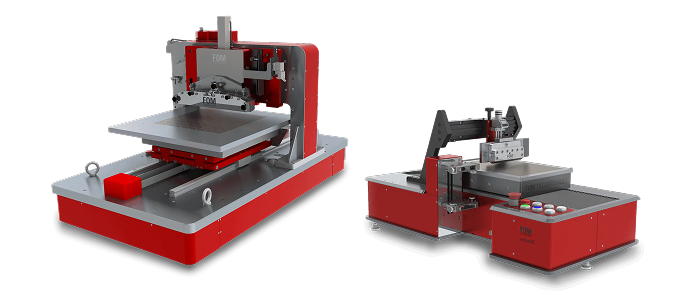
Sheet-based coating
Recipe development on small samples, with fast setup and minimal material use. Glovebox-ready for air- and moisture-sensitive materials.
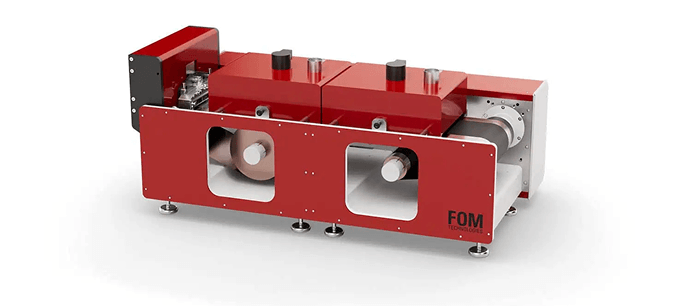
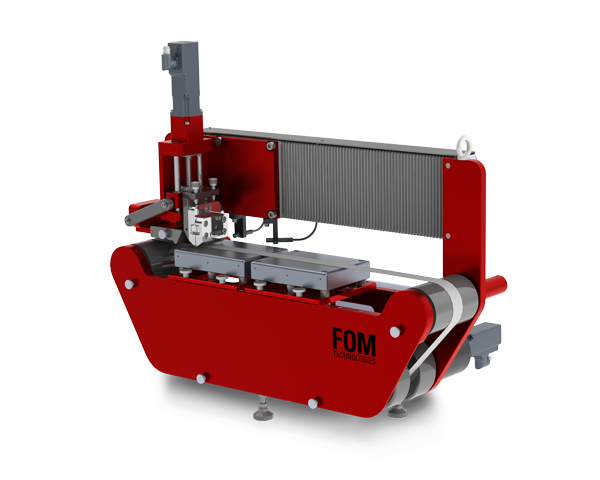
Lab-scale roll-to-roll
The bridge to continuous processing, using the same slot-die head. Longer substrates, controlled drying, and optional in-line metrology.
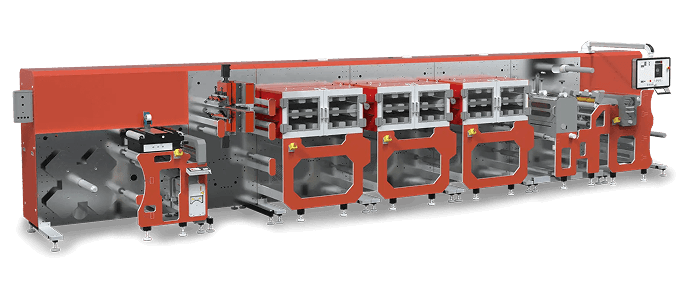
Pilot-scale roll-to-roll
Production-relevant widths and speeds, with modular options that keep your research open-ended. Build pilot data and de-risk manufacturing.

FOM’s Tensor coating software
Turns coating expertise into repeatable, scalable recipes. A clean, guided user interface takes you from setup to run with recipe-based control and storage to reuse coating protocols and test coating parameters in a structured way. The same intuitive workflow spans research tools and pilot lines, helping you scale by width and throughput without reworking your process. Advanced options—such as sequences, drying/profile management, web handling, and tension control.
Why it matters
- Save time with easy setup and reusable recipes.
- Get the same results every time with locked settings and history tracking.
- Scale with ease by using familiar software and protocols as you move from the lab to the pilot line

Expert-led training and research
FOM is staffed by scientists as well as engineers, and that team works with you directly — planning experiments, running samples, and troubleshooting the process. Whether you are new to slot-die coating or refining an established recipe, our application specialists shorten the path from a lab result to a qualified process.
- Research planning: a coating plan built around your material and constraints.
- Live training: private sessions led by a FOM scientist, online or at your site.
- Research services: we coat in the FOM laboratory and return samples with the process data.
- Book a scientist: hourly access to troubleshoot a specific issue.
- Technology demos: see a live coating run and assess it against your own materials.
Training, research services and technical resources are collected on our Science & Learning pages.
Get the application insights
Download our free application insights to see how precision coating makes film formation measurable
Exfoliated nanosheets, sol-gel precursors, and quantum dot inks are shear-sensitive, expensive by the milliliter, and the property being engineered depends on how the film forms rather than only on what is in it. This application insight sets out the material systems slot-die coating suits, the challenges each presents, and how the FOM photonR2R makes film formation observable inside a synchrotron beamline.