
Advantages of slot-die coating in carbon capture & DAC
Slot-die coating meters the formulation before it reaches the substrate, so film structure becomes a set parameter rather than a result of how the material happened to spread.
Uniform thickness across the width
Coat weight holds from edge to edge, and holds as width increases to pilot scale. That consistency is what makes a capture figure measured on a coupon mean something on a full sheet.
Clean edges with thick inks
High-solids sorbent slurries coat without beading or striping, because the flow is metered and enclosed rather than spread. The usable process window stays wide even as viscosity rises.
Adhesion on flexible supports
Fine gap control and primer options support bonds that hold through the heat and humidity cycling a capture device sees in service. Delamination stops being the failure mode that ends a trial.
Controlled drying for pore structure
Configurable heating zones set porosity and prevent the surface cracking that thick sorbent layers are prone to. Drying becomes a variable you tune rather than a step you survive.
A protected environment for sensitive chemistries
An enclosed flow path with humidity and temperature control keeps amine and MOF formulations intact between container and substrate. Glovebox configurations are available where the chemistry requires them.
Thin, uniform selective layers
Precise gap and flow control produce dense selective skins thin enough for useful flux, covering porous supports without pinholes. Membrane performance follows the recipe rather than the operator.
What layers to coat with slot-die
Layer stacks vary by process, but slot-die coating suits functional films that benefit from pre-metered deposition and controlled drying. In the diagrams below, layers shown in gold are slot-die coatable; the others are substrates and supports, or are usually formed by other methods. Films typically run from around 100 nm to tens of micrometers, with thickness set by ink rheology, wet gap, speed, and oven profile.
Direct air capture architecture

- Breathable overcoat layer
- Porous transport layer
- Active sorbent layer (amine- or MOF-based)
- Adhesion / primer
- Porous polymer substrate
Gold = slot-die coatable layers
CO₂-selective polymer membrane

- Protective topcoat
- Dense selective skin
- Porous support
Gold = slot-die coatable layers
Typical coating challenges
Capture performance is set by film structure, and sorbent and MOF formulations are among the hardest materials to coat evenly

Scaling lab inks to large areas
Coat weight and porosity across pilot widths determine capture efficiency, pressure drop, and whether results reproduce

Variable rheology
High-solids sorbent slurries bead at the edges and stripe unevenly, producing defects and wasting expensive formulation

Drying and porosity tuning
Pore structure sets capacity and kinetics; poor drying causes cracking, pore collapse, or dead surfaces

Adhesion on flexible supports
Layers detach under heat or humidity, which shows up as early failure rather than as a coating defect

Moisture-sensitive chemistries
Some amines and MOFs degrade without controlled humidity and temperature, and some raise handling risks

Membrane control
Flux and selectivity depend on a thin, pinhole-free selective layer covering a porous support evenly
Case spotlight: scaling CO₂ electrolysis for carbon transformation
Coating large-area MEAs for CO₂ reduction
Challenge
A carbon transformation company converting CO₂ into industrial products and sustainable fuels needed membrane electrode assemblies designed for CO₂ reduction, scaled from small lab samples to pilot-ready 300 × 300 mm. That meant coating low-viscosity carbon slurries onto sensitive polymer membranes. Manual methods could not hold uniformity over that area, and the catalyst inks were too expensive to lose to overspray or edge effects.
Approach
The company deployed a FOM slot-die sheet coating system, selected for large-area substrates and a heated vacuum chuck to hold membrane flatness and control drying kinetics. The closed, pre-metered flow path limited waste of the catalyst slurry and prevented premature drying inside the head, while the heated chuck and tuned coating speed locked in a process window where the low-viscosity ink dried evenly without disturbing the membrane beneath it.
Outcome
The team gained the ability to coat large-area MEAs with far less material waste, and a standardized method for testing and refining catalyst layers. That gives them a technical route from lab-scale research toward industrial-scale CO₂ transformation.

A solution for every stage of your research
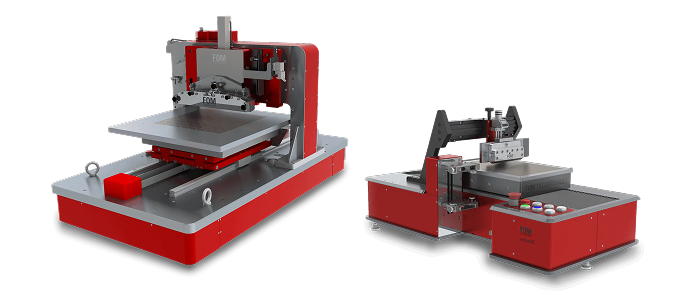
Sheet-based coating
Recipe development on small samples, with fast setup and minimal material use. Glovebox-ready for air- and moisture-sensitive materials.
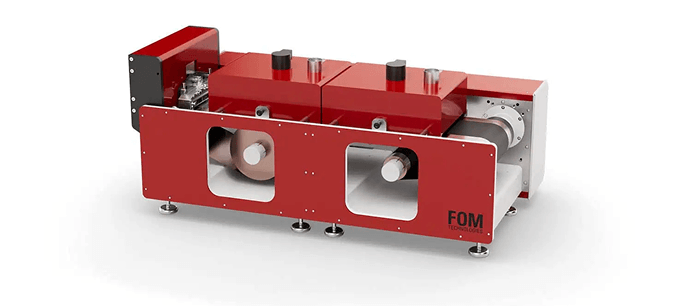
Lab-scale roll-to-roll
The bridge to continuous processing, using the same slot-die head. Longer substrates, controlled drying, and optional in-line metrology.
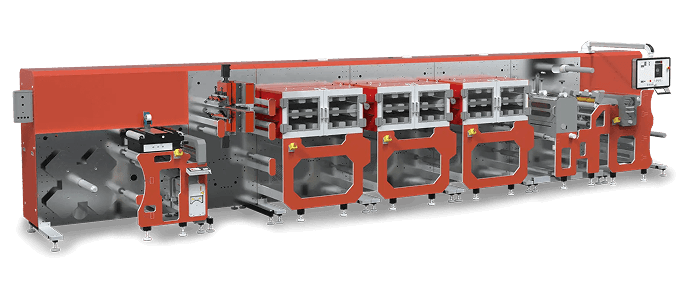
Pilot-scale roll-to-roll
Production-relevant widths and speeds, with modular options that keep your research open-ended. Build pilot data and de-risk manufacturing.

FOM’s Tensor coating software
Turns coating expertise into repeatable, scalable recipes. A clean, guided user interface takes you from setup to run with recipe-based control and storage to reuse coating protocols and test coating parameters in a structured way. The same intuitive workflow spans research tools and pilot lines, helping you scale by width and throughput without reworking your process. Advanced options—such as sequences, drying/profile management, web handling, and tension control.
Why it matters
- Save time with easy setup and reusable recipes.
- Get the same results every time with locked settings and history tracking.
- Scale with ease by using familiar software and protocols as you move from the lab to the pilot line

Expert-led training and research
FOM is staffed by scientists as well as engineers, and that team works with you directly — planning experiments, running samples, and troubleshooting the process. Whether you are new to slot-die coating or refining an established recipe, our application specialists shorten the path from a lab result to a qualified process.
- Research planning: a coating plan built around your material and constraints.
- Live training: private sessions led by a FOM scientist, online or at your site.
- Research services: we coat in the FOM laboratory and return samples with the process data.
- Book a scientist: hourly access to troubleshoot a specific issue.
- Technology demos: see a live coating run and assess it against your own materials.
Training, research services and technical resources are collected on our Science & Learning pages.
Get the application insights
Download our free application insights to see how precision coating accelerates carbon capture research
Sorbent layers, catalytic films, and membrane coatings all depend on structure that holds as area grows. This application insight sets out where slot-die coating fits across solid sorbents, CO₂-selective membranes, MOF composites, and structured contactors, and what it takes to carry a coating recipe from lab-scale DAC research to pilot-scale deployment.
