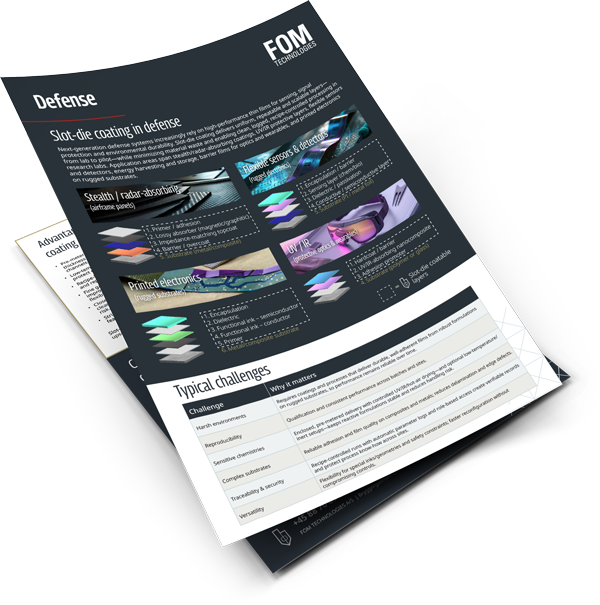
Advantages of slot-die coating in defense
Slot-die coating ensures process reliability and upscaling potential for defense devices, addressing the challenges listed later on this page with specific technical benefits.
Uniform layers for extreme durability
Slot-die coating applies perfectly even films that eliminate thin spots where failure might occur. This ensures that protective layers remain reliable even under the most extreme field conditions.
Stronger bonds on rugged materials
High-precision gap control ensures that coatings stick firmly to tough surfaces like metals and composites. This prevents peeling or delamination on critical components such as airframe panels or flexible electronics.
Stability for sensitive chemistries
An enclosed, pre-metered process protects reactive formulations from air and contaminants. This keeps delicate materials stable throughout the process and reduces safety risks during production.
Automatic records for mission security
Every run is digitally logged to protect sensitive process data and intellectual property. This generates a secure, verifiable history of the work, making military qualification faster and more reliable.
Identical results across every batch
Recipe-locked parameters ensure that every coating run is a perfect match. This allows for consistent performance that can be easily reproduced across multiple research sites.
Seamless scaling to pilot production
The technology allows a smooth transition from small lab samples to continuous pilot rolls without changing the core “recipe”. This makes it possible to increase production speed and width while maintaining proven quality.
What layers to coat with slot-die
Layer stacks vary by specific defense application, but slot-die coating is the standard for functional films that benefit from pre-metered deposition and controlled drying. In the diagrams below, layers shown in gold — such as lossy absorbers, dielectrics, and sensing layers — are slot-die coatable; others are typically rugged substrates or metallic contacts. Thickness ranges depend on ink rheology, wet gap, speed, and drying profile.
Stealth / radar-absorbing
(airframe panels)

- Primer / adhesion
- Lossy absorber (magnetic/graphitic)
- Impedance-matching topcoat
- Barrier / overcoat
- Substrate (metal/composite)
Gold = slot-die coatable layers
Printed electronics
(rugged panels)

- Encapsulation / barrier
- Sensing layer (chem/bio)
- Dielectric / passivation
- Conductive / semiconductive layer
- Substrate (PI / metal foil)
Gold = slot-die coatable layers
Flexible sensors & detectors
(rugged electronics)
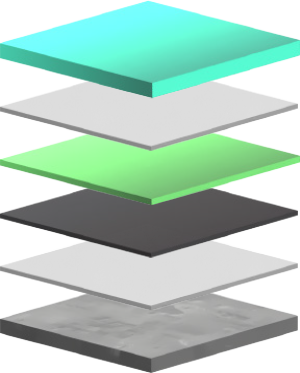
- Encapsulation
- Dielectric
- Functional ink – semiconductor
- Functional ink – conductor
- Primer
- Metal/composite substrate
Gold = slot-die coatable layers
UV / IR
(protective optics & wearables)
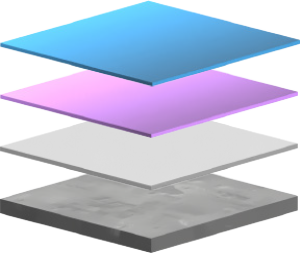
- Hardcoat / barrier
- UV/IR-absorbing nanocomposite
- Adhesion promoter
- Substrate (polymer or glass)
Gold = slot-die coatable layers
Typical coating challenges
Developing advanced materials for defense applications involves overcoming strict performance and security constraints

Harsh environment durability
Defense systems must withstand extreme conditions, requiring durable films that maintain high performance and reliable adhesion

Military-grade reproducibility
Qualification depends on consistency; every batch must be identical across all research sites to ensure reliability in the field

Sensitive chemical stability
Advanced defense materials are often reactive, making it critical to keep formulations stable during the process for safety and quality

Bonding to complex materials
Thin films often struggle to stick to metals or composites, making high-quality adhesion vital to prevent peeling and defects

Traceability and mission security
Protecting process know-how with verifiable records and secure data logs is a core requirement for defense research security

Speed and versatility
Quickly adapting to specialized inks and complex geometries is essential for accelerating critical development and testing cycles
Case spotlight: standardizing roll-to-roll electrode coating for a defense power program
Cutting cross-web variation on a fieldable power program
Challenge
A U.S. defense research lab needed very uniform, ultra-thin electrode coatings on metal foils for a fieldable power program. Benchtop methods couldn't meet roll-to-roll requirements or the cross-web uniformity target. Early trials showed ~15% thickness variation — too high for qualification.
Approach
The team moved to a FOM R2R slot-die line (≈300 mm web) with recipe-controlled settings. They coated graphite/carbon-black slurries onto foils and used staged drying (IR pre-heat followed by controlled oven zones). A clear coating window — speed, gap, and wet-to-dry correlation — was defined and run the same way by all operators.
Outcome
Within the first phase, the lab reduced edge-to-edge variation from ~15% to ~8%, created a repeatable coating window, and cut material waste — accelerating experiment cycles and establishing a clear path to pilot-ready electrode rolls.
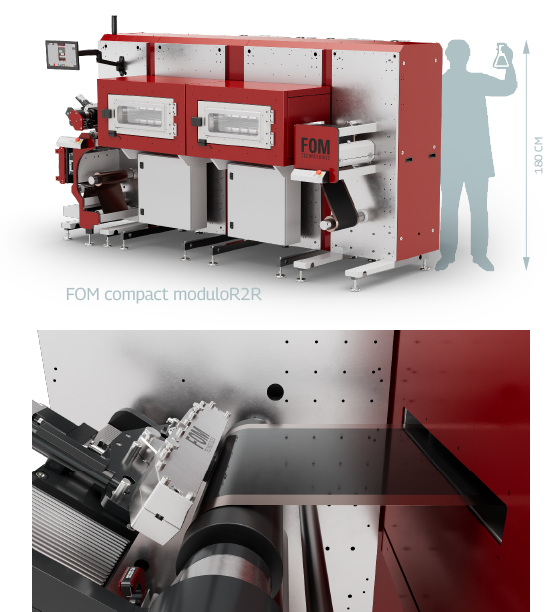
A solution for every stage of your research
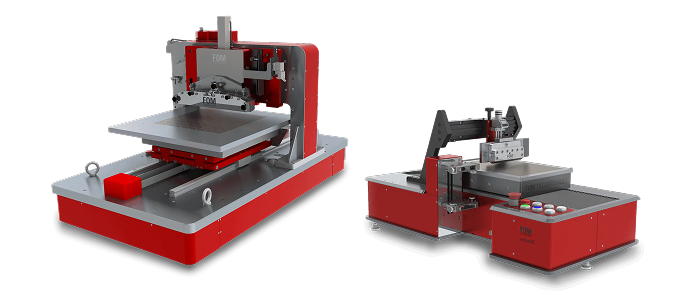
Sheet-based coating
Recipe development on small samples, with fast setup and minimal material use. Glovebox-ready for air- and moisture-sensitive materials.
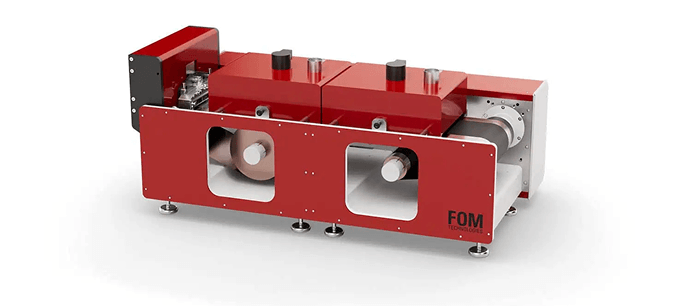
Lab-scale roll-to-roll
The bridge to continuous processing, using the same slot-die head. Longer substrates, controlled drying, and optional in-line metrology.
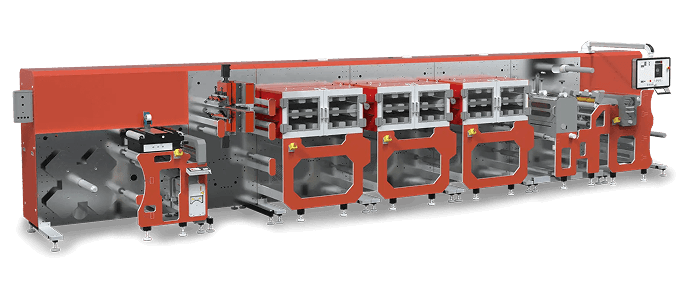
Pilot-scale roll-to-roll
Production-relevant widths and speeds, with modular options that keep your research open-ended. Build pilot data and de-risk manufacturing.

FOM’s Tensor coating software
Turns coating expertise into repeatable, scalable recipes. A clean, guided user interface takes you from setup to run with recipe-based control and storage to reuse coating protocols and test coating parameters in a structured way. The same intuitive workflow spans research tools and pilot lines, helping you scale by width and throughput without reworking your process. Advanced options—such as sequences, drying/profile management, web handling, and tension control.
Why it matters
- Save time with easy setup and reusable recipes.
- Get the same results every time with locked settings and history tracking.
- Scale with ease by using familiar software and protocols as you move from the lab to the pilot line

Expert-led training and research
FOM is staffed by scientists as well as engineers, and that team works with you directly — planning experiments, running samples, and troubleshooting the process. Whether you are new to slot-die coating or refining an established recipe, our application specialists shorten the path from a lab result to a qualified process.
- Research planning: a coating plan built around your material and constraints.
- Live training: private sessions led by a FOM scientist, online or at your site.
- Research services: we coat in the FOM laboratory and return samples with the process data.
- Book a scientist: hourly access to troubleshoot a specific issue.
- Technology demos: see a live coating run and assess it against your own materials.
Training, research services and technical resources are collected on our Science & Learning pages.
Get the application insights
Download our free application insights to see how precision coating supports mission-critical thin films
From stealth layers and protective optics to flexible sensors and printed electronics, defense programs need thin films that are uniform, reproducible, and traceable. This application insight sets out how FOM Technologies' slot-die coating systems help researchers hold a coating window on rugged substrates, document every run, and move from lab samples to pilot rolls.
See how recipe-controlled coating shortens qualification cycles and reduces the material waste that comes with expensive specialized inks.