
Advantages of slot-die coating in the hydrogen industry: Fuel cells and electrolyzers
Slot-die coating ensures process reliability and upscaling potential for fuel cells & electrolyzers, addressing the challenges listed later on this page with specific technical benefits.
Pre-metered material control
Precision pumps and locked flow rates put the ink on the substrate rather than into overspray, which matters directly when the material is platinum or iridium. Coat weight follows the recipe, not the operator.
Rheology handling
Slot-die heads and internal shim geometries are specified for the ink, so complex catalyst viscosities coat uniformly and without edge beading. Head choice and gap do the work that reformulation would otherwise have to.
Interface durability
Defect-free coating and tuned ink-to-substrate interaction improve bond strength between functional layers. Interfaces hold through the humidity and thermal cycling the device sees in service.
Programmed drying profiles
Staged IR and hot-air drying let drying kinetics be tuned rather than accepted, which is what prevents mud-cracking. Pore structure becomes a controlled outcome instead of a consequence.
Membrane-safe handling
Vacuum-assisted heating and non-contact deposition keep thin electrolyte membranes flat and unstressed. Swelling and wrinkling stop being the limit on what can be coated.
Scale-up on the same recipe
The same coating principle runs from benchtop to pilot, so a stable process window transfers rather than being rebuilt. Width and line speed become the variables.
What layers to coat with slot-die
Fuel cells and electrolysers share a nearly identical core structure of two electrodes separated by an electrolyte, though they operate in reverse. Stack architectures depend on the technology - PEM, AEM or Solid Oxide — but slot-die coating is a core method for functional layers that need high catalyst utilization and precise thickness control. In the diagrams below, layers shown in gold — catalyst layers, ionomer membranes, and micro-porous layers — are slot-die coatable; the others are typically structural bipolar plates or carbon-fiber gas diffusion layers.
PEM / AEM
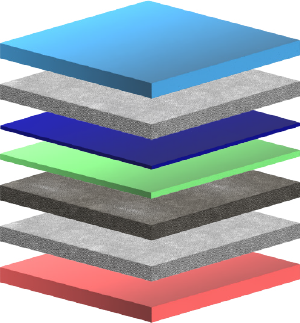
- Gas flow channel
- Gas diffusion layer
- Anode catalyst layer
- Proton/anion exchange membrane
- Cathode catalyst layer
- Gas diffusion layer
- Gas flow channel
Gold = slot-die coatable layers
Solid oxide
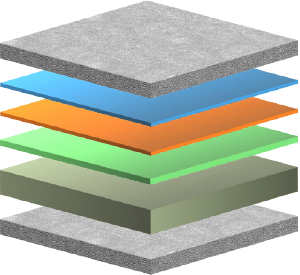
- Interconnect
- Anode support layer
- Anode layer
- Electrolyte (YSZ or similar)
- Cathode functional layer
- Interconnect
Gold = slot-die coatable layers
Typical coating challenges
Catalyst layers and membranes have to deliver conductivity, porosity, and durability at once, from materials that cost more per gram than the device sells for

Catalyst cost and utilization
Platinum and iridium are expensive enough that non-uniformity or waste changes whether a device is economically viable

Variable slurry rheology
Catalyst inks have complex flow behavior that produces edge defects, uneven thickness, or clogging during deposition

Drying and porosity tuning
Poor drying kinetics cause mud-cracking or pore collapse, which undermines electrochemical activity and durability

Interface adhesion
Bonds between functional layers have to survive thermal and humidity cycling in operation, or the stack delaminates

Membrane sensitivity
Thin polymer electrolyte membranes swell and wrinkle when exposed to solvent or heat during coating

Scaling lab results
Benchtop methods rarely reproduce the same particle dispersion and film properties at pilot or industrial volume
A solution for every stage of your research
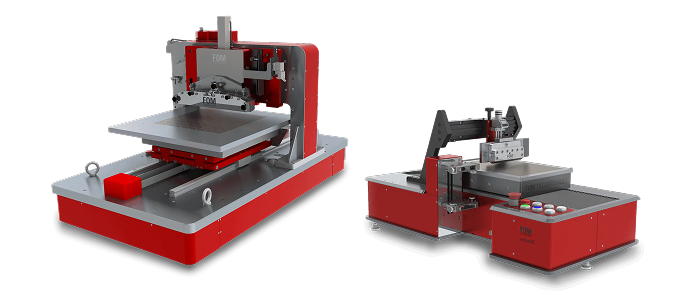
Sheet-based coating
Recipe development on small samples, with fast setup and minimal material use. Glovebox-ready for air- and moisture-sensitive materials.
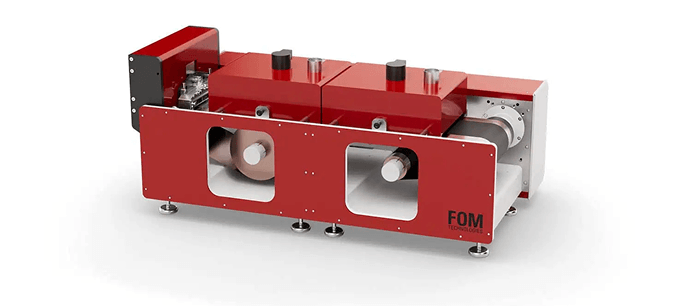
Lab-scale roll-to-roll
The bridge to continuous processing, using the same slot-die head. Longer substrates, controlled drying, and optional in-line metrology.
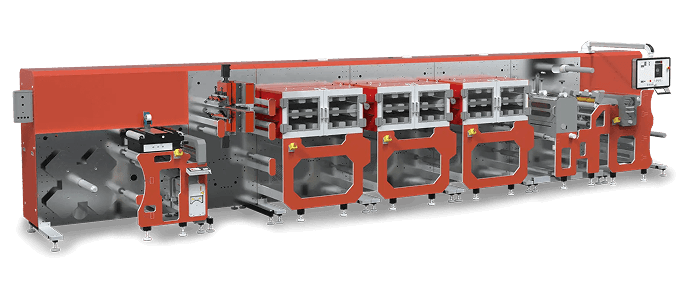
Pilot-scale roll-to-roll
Production-relevant widths and speeds, with modular options that keep your research open-ended. Build pilot data and de-risk manufacturing.

FOM’s Tensor coating software
Turns coating expertise into repeatable, scalable recipes. A clean, guided user interface takes you from setup to run with recipe-based control and storage to reuse coating protocols and test coating parameters in a structured way. The same intuitive workflow spans research tools and pilot lines, helping you scale by width and throughput without reworking your process. Advanced options—such as sequences, drying/profile management, web handling, and tension control.
Why it matters
- Save time with easy setup and reusable recipes.
- Get the same results every time with locked settings and history tracking.
- Scale with ease by using familiar software and protocols as you move from the lab to the pilot line

Expert-led training and research
FOM is staffed by scientists as well as engineers, and that team works with you directly — planning experiments, running samples, and troubleshooting the process. Whether you are new to slot-die coating or refining an established recipe, our application specialists shorten the path from a lab result to a qualified process.
- Research planning: a coating plan built around your material and constraints.
- Live training: private sessions led by a FOM scientist, online or at your site.
- Research services: we coat in the FOM laboratory and return samples with the process data.
- Book a scientist: hourly access to troubleshoot a specific issue.
- Technology demos: see a live coating run and assess it against your own materials.
Training, research services and technical resources are collected on our Science & Learning pages.
Get the application insights
Download our free application insights to see how precision coating accelerates hydrogen research
Catalyst layers, membrane electrode assemblies, and ion-exchange membranes all need uniformity that holds as area grows. This application insight sets out where slot-die coating fits across PEM, AEM, and solid oxide stacks, how it reduces waste of precious-metal inks, and what it takes to carry a coating recipe from benchtop to pilot.
