
Why the choice of machine matters
The machine decides which parts of the coating process you can control and measure. That in turn decides which questions your research can answer.
The substrate decides the format
Glass, wafers and other rigid substrates need a sheet coater. A moving web cannot carry them.
New materials come in small amounts
Often only a few millilitres. How many trials that allows depends on the dead volume in the fluid path and the width of the head.
Viscosity decides the setup, not the machine
Viscosity sets the slot-die head, the tubing and the pump. The same machine handles thin and thick fluids once it is set up for them.
Some effects only appear on a moving web
Web tension, drying time and long-run stability. If your work depends on these, you need a roll-to-roll machine to see them.
A poor match shows up late
A limit found after the formulation is finished cannot be solved by changing settings. It needs a different machine, and the work is repeated.
A solution for every stage of your research
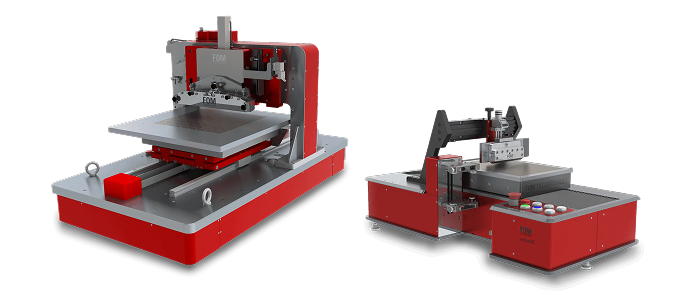
Sheet-based coating
Recipe development on small samples, with fast setup and minimal material use. Glovebox-ready for air- and moisture-sensitive materials.
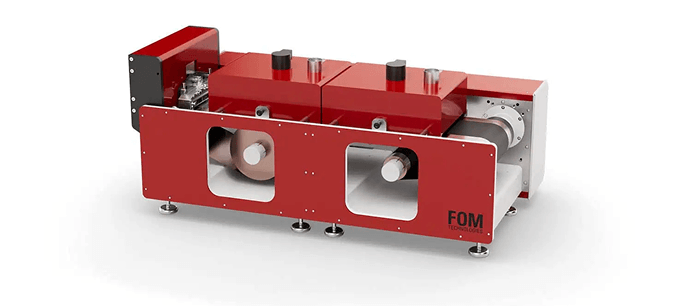
Lab-scale roll-to-roll
The bridge to continuous processing, using the same slot-die head. Longer substrates, controlled drying, and optional in-line metrology.
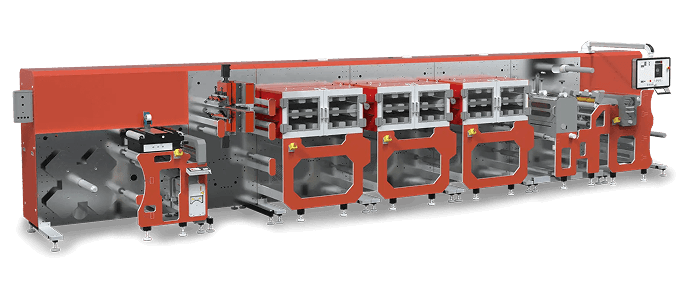
Pilot-scale roll-to-roll
Production-relevant widths and speeds, with modular options that keep your research open-ended. Build pilot data and de-risk manufacturing.
Four things to check
Most projects are decided by two or three of these, not all four. Take them in order: the first often rules out a whole format, which makes the rest easier.

Substrate
Glass, wafers and other rigid substrates need sheet-based coating, because a moving web cannot carry them. Flexible film works in all three formats, so the three points below decide the choice.

Material volume
New materials often come in millilitres. Two things decide how far that goes: the dead volume in the slot-die head and fluid path, and the width of the head. FOM heads keep dead volume low, and a pump-back function returns fluid from the line after coating.

Viscosity
Viscosity sets the slot-die head, tubing and pump. It does not set the machine. Below about 1,000 cPs a standard set is used. Above that, a high-viscosity set. Slot-die head heating up to 80 °C is available across the range.

Coating width
Slot-die heads cover 1 mm to 500 mm. Wider coatings are harder to keep uniform, because edge effects, pressure distribution inside the manifold and drying gradients all grow with width.
What transfers between formats
Slot-die coating is pre-metered. Wet film thickness comes from pump rate, coating speed and coating width, not from a mechanical gap. This holds in every format, which is why a process developed on one FOM machine still means something on another.
What changes between formats is not quality. It is which effects are present. Sheet-based coating isolates the fluid and the substrate, so it suits work about the formulation itself, about stacking layers, or about devices on rigid substrates. Roll-to-roll coating adds web tension, drying time and long-run stability, so it suits work where those effects are the research question.
The question is therefore which effects your work needs to address, not how far along the project is. A group working on rigid-substrate photovoltaics may never need a web. A group developing electrode processes for a production line needs one from the start.
The same in every format
- Wet film thickness relationship
- How the formulation behaves
- Slot-die head selection
- Coating window limits
Only on a moving web
- Web tension effects
- Drying time
- Long-run stability
- Layer-to-layer registration

The FOM slot-die coating portfolio, shown to scale against a 180 cm figure.
Frequently asked questions
Can a slot-die coater coat rigid substrates such as glass or silicon wafers?
Yes, with a sheet coater. Sheet-based machines hold a single substrate flat on a heated vacuum chuck while the slot-die head moves across it, so the substrate does not need to bend. Roll-based and roll-to-roll machines carry the substrate on a drum or a moving web, which only works with flexible material. If your device is built on glass or a wafer, sheet-based coating is the format to look at.
How much material is needed to run a slot-die coating trial?
Less than most other coating methods, because slot-die coating is pre-metered: almost all the fluid that is pumped reaches the substrate. Two things decide how far a small volume goes. The first is dead volume, material that fills the head and tubing but never gets coated. The second is the width of the slot-die head, since a narrower head uses less fluid per pass. FOM heads are built with low dead volume, and a pump-back function returns fluid from the line after coating, so a few millilitres of a new material is enough for early trials.
What ink viscosity can a slot-die coater handle?
A wide range, but the viscosity decides the setup rather than the machine. Below about 1,000 cPs, a standard slot-die head, tubing and pump are used. This covers most solution-processed materials, such as perovskite precursors, conductive polymers and catalyst inks. Above about 1,000 cPs, a dedicated high-viscosity set is needed: heavier tubing, a pump matched to the pressure, and a head designed for the flow. Battery electrode slurries and paste-like formulations sit in this group. Slot-die head heating up to 80 °C is available across the range, which helps with temperature-sensitive and shear-thinning fluids.
What coating widths are available?
FOM slot-die heads cover coating widths from 1 mm to 500 mm. Which widths a given machine accepts depends on its substrate handling, so check the datasheet for the platform you are considering. Wider coatings are harder to keep uniform, because edge effects, pressure distribution inside the head manifold and drying gradients all grow with width. For early screening work a narrow head is usually the better choice, since it also uses less material per pass.
Do I need a roll-to-roll machine for battery or solar research?
Not necessarily. It depends on whether the effects that only appear on a moving web are part of your research question. Web tension, drying time and long-run stability cannot be observed on a static substrate, so work that depends on them needs a roll-to-roll machine. Work about the formulation itself, about stacking layers, or about devices on rigid substrates does not. A group developing perovskite cells on glass may never need a web. A group developing electrode processes for a production line needs one from the start.
Can a process developed on one FOM coater be used on another?
In large part, yes. Slot-die coating is pre-metered, so wet film thickness comes from pump rate, coating speed and coating width rather than from a mechanical gap. That relationship holds in every format, which means the coating window, the head selection and the way the formulation behaves all carry over. What does not carry over is anything that only exists on a moving web: web tension, drying time, long-run stability and layer-to-layer registration. Those have to be established on the format that produces them.
What is the difference between lab-scale and pilot-scale roll-to-roll?
Both coat a continuous web, and both include drying. The difference is size and configuration. Lab-scale machines fit on a benchtop, use narrower webs and smaller roll diameters, and are built for developing and testing a process with limited material. Pilot-scale lines are floor-standing, take wider webs, and have several drying sections, so they can run under production conditions and produce the quantities a pilot or pre-production run needs. Both are roll-to-roll: lab-scale is not a trial version of pilot-scale, and many groups only ever need one of the two.
Read more on the topic

Film uniformity in PEDOT:PSS coatings: why it matters and how to achieve it
Low-viscosity PEDOT:PSS is difficult to coat evenly over large areas. This article explains why film uniformity drives device performance and how the FOM alphaSC achieved below 5% thickness variation on 300 × […]

Enhancing slot-die coating with AI and custom-engineered tools
University of Washington PhD candidate Ethan Schwartz describes his motorized air knife, his use of machine learning to optimize coating parameters, and how he transfers spin-coated perovskite recipes to slot-die coating on […]

Improving the sustainability of products in Europe
The EU is moving toward a circular economy with ecodesign requirements for sustainable products. This article outlines the Circular Economy Action Plan, the proposed ecodesign framework, digital product passports, and public opinion […]

Bibliometric maps of slot-die coating
This article presents an overview of slot-die coating research. A distance-based bibliometric map shows how slot-die coating keywords co-occur in the literature, giving a graphical view of the field.

Printing, coating, metering & the slot-die process
This article introduces the basics of modern printing and coating and explains how wet layer thickness is controlled in different coating processes, including slot-die coating.

The link between slot-die height and line speed
Slot-die coating is a pre-metered process that depends on a stable coating bead. This article explains the relationship between slot-die height and line speed, and how the coating gap can serve as […]

How to choose the right slot-die coater
Choosing a slot-die coater starts with your ink, your substrate, and your goals. This article covers the key questions, from ink viscosity and substrate type to material quantities and plans for scale-up.